


If you’re a STEM or healthcare expert running your own business, you may have asked yourself this question at some point: Am I a freelancer… or a consultant?
The two terms are often used interchangeably, but they carry very different weight, especially when it comes to how you’re perceived, how much you charge, and how you structure your services.
Let’s break it down, because choosing the right positioning can make or break your business model.
What Is a Freelancer?
A freelancer is typically someone brought in to complete a specific task, often on a short-term or per-project basis. Common STEM freelancing services include medical or technical writing, literature reviews or meta-analyses, data visualization, and slide deck design for grant pitches. Freelancers are usually paid for time or output giving them flexibility and independence.
Freelancers often:
- Work with multiple clients at once
- Bill hourly, per word, or per deliverable
- Operate under someone else’s strategy or direction
- Do execution-heavy work like writing, editing, or data analysis
- May feel pressure to compete on price or speed
There’s absolutely nothing wrong with freelancing especially in the early stages of your business. Being a freelancer can help you with (relatively) quick income, gain experience with hands-on experience and explore different niches. But it can be difficult to raise your rates, delegate tasks, or scale your income unless you shift your business model.
What Is a Consultant?
A consultant, on the other hand, is positioned as a strategic expert or advisor. They have deep expertise in certain area and are brought in to shape the plan, solve problems, and lead projects rather than just do the work. In STEM, consultants might help a biotech company navigate regulatory submissions, advise a medtech startup on a clinical trial communication strategy, design high-level training programs for pharma teams, or help health startups develop a market entry strategy.

Consultants often:
- Offer high-ticket, solution-focused services
- Provide frameworks, strategy, or advisory insight
- Lead or collaborate on big-picture initiatives
- Get brought in for their expertise not just their execution
- Attract higher-quality clients and longer-term contracts
Why This Distinction Matters in STEM & Healthcare
When you call yourself a freelancer, you may unintentionally position yourself as replaceable. When you present yourself as a consultant, you signal authority, experience, and strategic value. And guess what? The pay reflects that.
Consultants tend to:
- Charge 2–5× more than freelancers for similar deliverables
- Get hired earlier in the project lifecycle (where strategy happens)
- Have more say in timelines, pricing, and scope
- Get referrals through networks, not just job boards
- Retain clients longer (often through retainers or advisory packages)
If you’re constantly feeling underpaid, micromanaged, or ghosted by flaky clients, you might have all the right skills but have suboptimal positioning for your services.
Also read: What to Do When You’re Fully Booked But Under-Earning
How to Tell If You’re Acting Like a Freelancer or Consultant

Even if you technically do both types of work (e.g., offer a done-for-you service and a 90-min strategy call), it’s helpful to evaluate your current offers and client relationships:
- Are clients bringing you in for your insight or just your ability to execute?
- Do you set the scope and pricing, or do they?
- Are you leading projects, or following instructions?
- Are your contracts built for results or simple tasks?
- Do you feel like a partner or a plug-and-play contractor?
If you’re starting to feel like you’ve outgrown the freelance label, you’re not alone. Many of my clients hit this point and realize: “I want to be seen as the expert I actually am.”
Making the Shift from Freelancer to Consultant
If you’re ready to move into a higher level of leadership in your business, here are five things you can start doing:
1. Audit Your Offers
Are you selling hourly services or packaging your skills into outcome-based offers? Start creating signature packages that reflect the transformation you provide!
2. Elevate Your Messaging
Ditch the “available for freelance work” messaging in your LinkedIn bio. Try something like “consulting for medtech teams looking to streamline regulatory communications” instead. Focus on results and expertise.
Get my LinkedIn profile checklist inside Sure Strides Society to position yourself as a credible expert and be found by the right people.
3. Change the Way You Onboard Clients
Consultants guide the scope and direction. That means using proper intake forms, setting the agenda, and offering strategic recommendations early.
4. Raise Your Rates
Consultants charge for value instead of time. Reframe your pricing to reflect your specialized knowledge, advanced credentials, and the cost of not hiring you.
5. Invest in Systems & Strategy
If you’re going to step into a leadership role in your business, you need back-end support to match. That includes contracts, workflows, onboarding systems, and visibility assets.
Here are some vetted legal contract templates to look professional and set clear expectations with your clients from the beginning.
You Get to Decide What You Call Yourself
There’s no legal line between “freelancer” and “consultant” but your title, positioning, and confidence all influence how you show up (and how you’re compensated). Below are some pros and cons of each path.
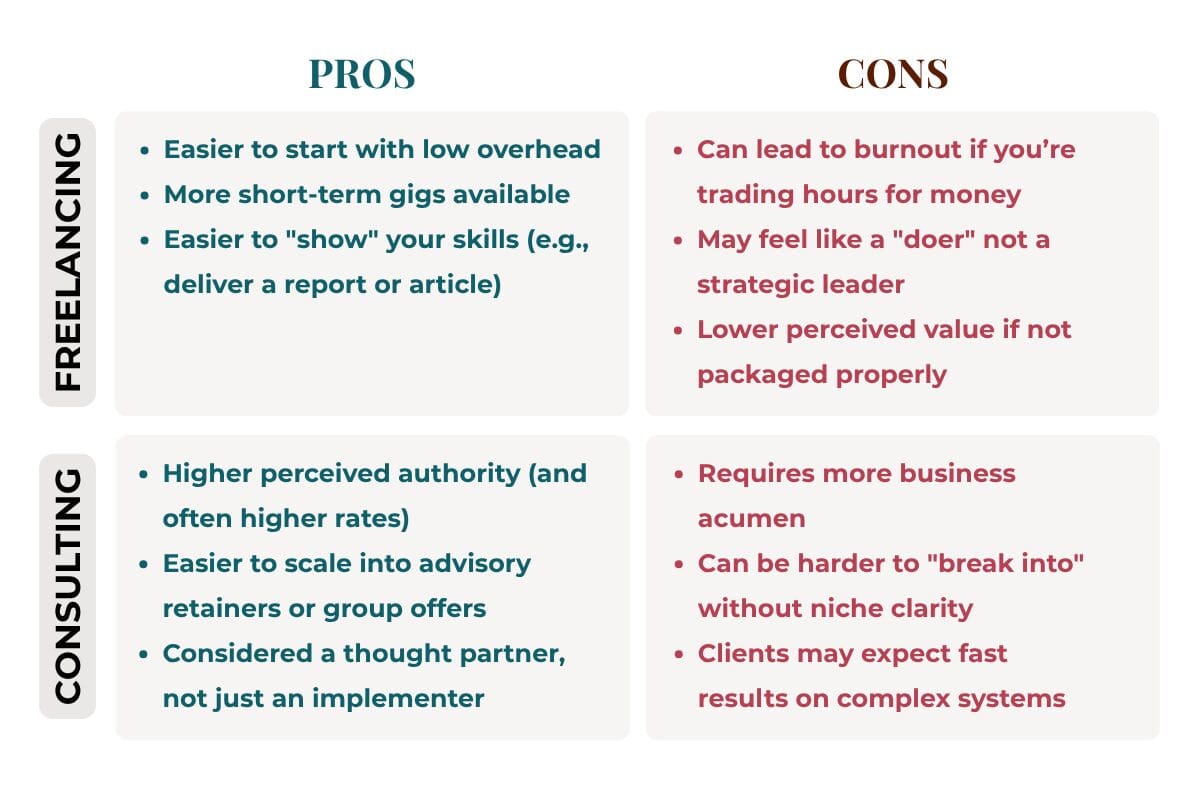
If you’ve got the credentials, experience, and depth of knowledge that STEM professionals are known for… you may already be operating like a consultant. You just haven’t claimed it yet.
Leave a Reply
entrepreneurship
What to do when you're fully booked but under-earning

FEATURED on the Blog

mindset
Overcoming sales objections as a freelancer

personal branding
How Thought Leadership can grow your business

leadership
What a $9,800 mastermind weekend taught me

digital products
Starting a membership when you don't feel ready
personal branding


Entrepreneurship
How to position your expertise and story so the right opportunities (and clients) find you.
personal branding
The inner work behind confident decisions, growth, money, boundaries, and long-term resilience as a founder.
mindset
Turn your knowledge and systems into scalable offers that create income beyond client work.
digital products
How to lead with clarity and confidence while maintaining your integrity.
leadership
FOUNDATIONAL RESOURCES
Business, simplified
How I manage money, payments, and cash flow as a service-based founder.
Finance


Legal
Contract templates to protect your work, set boundaries, and avoid scope creep.
The tools and platforms I use to run my businesses as a busy toddler mom.
Systems

These are the tools I use behind-the-scenes to keep my businesses running smoothly. If you care about getting paid on time, or having contracts and systems you can rely on, start here.
Sure Strides Society is where high-acheivers go when what used to work no longer does. Demand is there, but structure isn’t, and you’re booked but everything still depends on you. Join the community to refine your positioning, clean up your systems, and build offers that scale sustainably, so your business can finally hold the level you’re stepping into.
Build a business where your work is seen, valued, and supported
For STEM freelancers, consultants, and multi-passionate founders

Be the first to comment