


How to Turn Academic Expertise Into a Profitable Freelance or Consulting Business
June 22, 2026
June 22, 2026
–
If you’ve spent years collecting degrees, publishing papers, teaching, mentoring students, managing projects, reviewing manuscripts, analyzing data, or translating science for different audiences, you’ve probably thought,“I know I have valuable skills. I just don’t know what people would actually pay me for.”
As someone who went from being a broke PhD student to building a six-figure medical communications agency, I understand how disorienting it can feel to step outside academia and suddenly realize that no one teaches you how to package your expertise, communicate your value, or build a business around the parts of your work that energize you most.
Academia does a beautiful job of teaching us how to think critically, design experiments, synthesize evidence, and persevere through uncertainty. What it doesn’t teach us is that many of the skills we’ve spent years developing are incredibly valuable outside the university walls.
We become so accustomed to seeing our skills as expectations of our role that we forget they are actually highly specialized capabilities that businesses, organizations, and entrepreneurs are actively looking for.
You probably don’t need another degree, certification, or course before starting a freelance or consulting business. You simply need to learn how to recognize, package, and position the expertise you already have.
How to Translate Your Academic Skills
One of the biggest mindset shifts researchers and healthcare professionals need to make is understanding that academia and business reward very different things.
Academia rewards publications, grants, credentials, and intellectual rigor while business rewards clarity, outcomes, and solutions.
For years, I assumed that if I ever left academia, my options would be limited because I wasn’t a principal investigator, a clinician, or someone running a large research lab. Looking back, I can see that I had been collecting valuable business skills all along.
When I started my PhD, I genuinely looked forward to conducting experiments. I loved science and still do. But over time, I noticed that the parts of my work that came most naturally to me weren’t necessarily the experiments themselves. I enjoyed speaking with patients, building clinical databases from chart reviews, identifying patterns in messy datasets, creating systems, and translating scientific findings into stories, visuals, and practical insights that other people could actually understand and apply.
At the time, I didn’t recognize them as strengths because they felt easy to me. Ironically, the tasks I loved were often those my colleagues dreaded. I underestimated the skills I had spent years refining in art school because I was surrounded by brilliant PhD students.
Outside of academia, not everyone knows how to read a fifty-page clinical paper and summarize it into a two-page briefing document or a graphical abstract. Not everyone can manage competing priorities, facilitate workshops, interview patients, mentor junior researchers, or explain complex concepts to different audiences. The skills academics take for granted often become our most valuable assets.
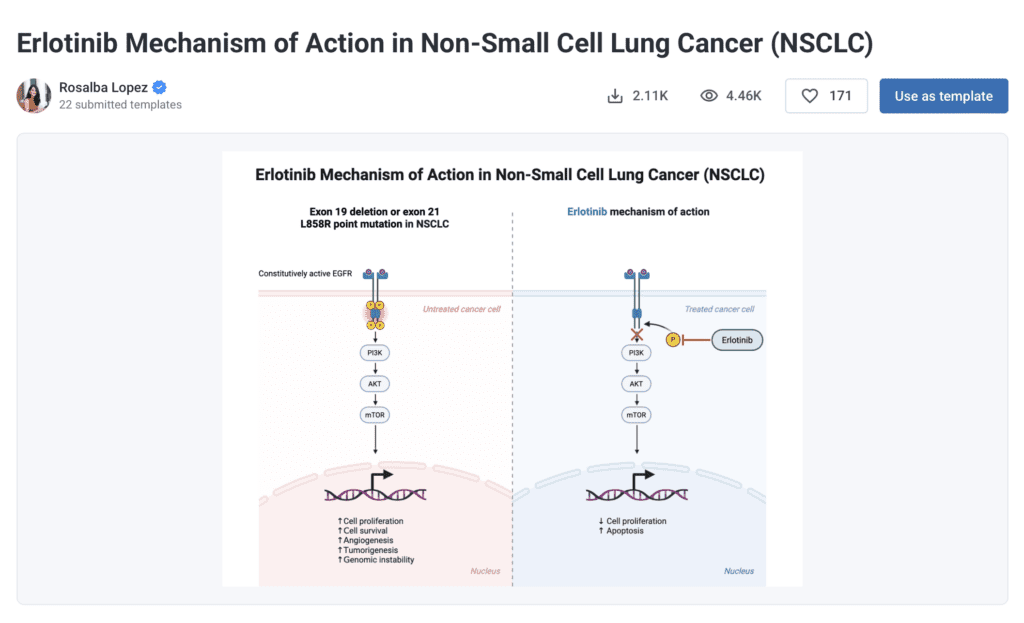
The challenge is that academia trained us to describe ourselves as researchers rather than problem solvers. And I hate to break it to you, but clients don’t wake up hoping to hire someone with a specific h-index. They want someone who can save them time, reduce uncertainty, communicate more effectively, streamline a process, or help them make better decisions.
Audit Your Skills
Forget what your degree says you can do for a minute. What do people consistently come to you for help with?
Do colleagues always send you manuscripts to review before submission? Do younger students come to you for advice because you’re particularly good at explaining difficult concepts? Did your supervisor rely on you to organize datasets because you enjoy building systems that everyone else finds tedious.
If someone regularly thanks you for making their life easier, there’s a good chance you’ve identified a skill that people outside the university would pay for. For example:
- A literature review can become evidence synthesis support.
- Grant writing experience can become funding strategy consulting.
- Teaching can become workshops or educational programming.
- Managing databases can evolve into systems consulting.
- Mentoring students can become career coaching.
- Presenting at conferences can translate into scientific storytelling services.
If there’s one thing I want you to take away from reading this, it’s that you don’t need to invent a brand-new identity to become a freelancer or consultant. Join the community and come to the next live meetup to learn how to repackage skills you’ve been using for years.
Sell Service Outcomes Before Credentials
One of the biggest differences between academia and entrepreneurship is that clients don’t typically purchase credentials. They purchase outcomes.
There’s nothing inherently wrong with saying “I have a PhD in neuroscience.”
But it doesn’t immediately tell someone why they should hire you.
Compare that with “I help biotech founders translate complex science into investor-ready materials.”
Or “I help healthcare professionals package their expertise into consulting offers that generate additional income streams.”
Suddenly, people understand not only what you do but also why it matters.
Practice an elevator pitch along the lines of: I help [specific audience] achieve [desired outcome] by using my expertise in [subject area or skill]. Don’t spend three months overthinking it. You don’t have to keep the same one forever. You can change it as you master your craft and evolve in your business.
Begin with Services Before Building Courses
Academics love learning. Unfortunately, that sometimes means we convince ourselves that we need to master every aspect of a new career path, build an extensive portfolio, or create an entire course ecosystem before we’ve ever worked with a paying client.
In reality, some of the most valuable market research comes from simply spending time with the people you hope to serve. Whether that’s through consulting, freelance projects, coaching calls, or even a small online community, listening closely to your audience can tell you far more about what they truly need than spending months creating in isolation.
Related: Starting a Membership When You Don’t Feel Ready: My Step-by-Step Story
I don’t think I could have built resources that people genuinely found useful if I hadn’t spent years listening to clients first. The templates, workshops, trainings, and community resources I offer in Sure Strides Society today were shaped by recurring questions, common roadblocks, and conversations with people navigating many of the same challenges.
Working directly with clients provides immediate feedback and generates cash flow. It helps you identify patterns, uncover unmet needs, collect testimonials, and refine your messaging. A one-hour consultation, manuscript review, workshop, VIP day, or retainer agreement may not sound as glamorous as passive income, but they often provide the clearest path toward building a sustainable business.
Many successful digital products are simply organized solutions to problems clients repeatedly asked someone to solve. Services and communities can help you gather that intelligence before investing significant time and energy into creating something people may not actually want.
Ignorance is costing you thousands
STEM professionals turning to freelancing and consulting often undercharge because no one ever taught them what their expertise is actually worth in the market. Unless you’re working with a mentor, you simply don’t know what you don’t know.
To give you a sense of how your expertise is valued outside academia, here are approximate industry benchmarks for common STEM consulting engagements.
Rates vary based on experience, specialization, geography, and scope, but seeing examples like these can help recalibrate what many academics believe is possible.
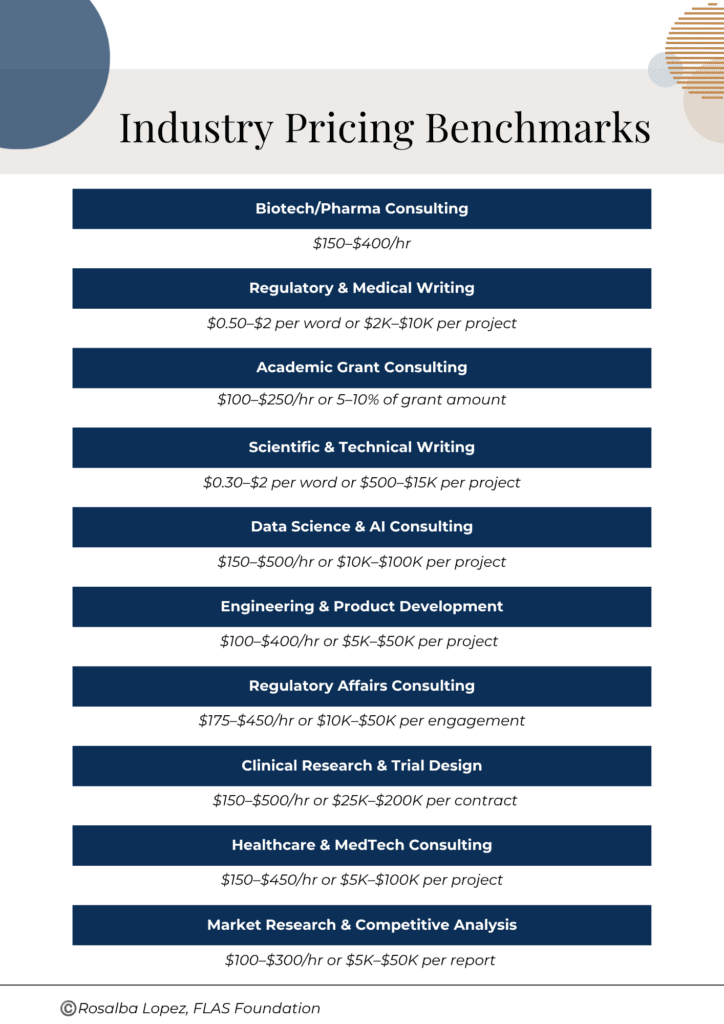
You’ve spent years—decades even—becoming an expert but you’re still pricing your work like a junior research assistant instead of a trusted advisor. Industry professionals aren’t paying for your time. They’re paying for faster drug approvals, stronger grant proposals, more funding, and ultimately, better patient outcomes.
Pricing transparency matters because without benchmarks, you’ll spend hours second guessing your proposals. And guessing leads to $1,200 projects that should have been $12,000 retainers.
Finding Clients Doesn’t Require Becoming an Influencer
Another misconception I see frequently is the belief that you need thousands of followers before anyone will hire you. Some of my earliest opportunities came from random conversations, long-term relationships, and referrals. Former collaborators became clients. Connections from graduate school opened unexpected doors. You never know who people know!
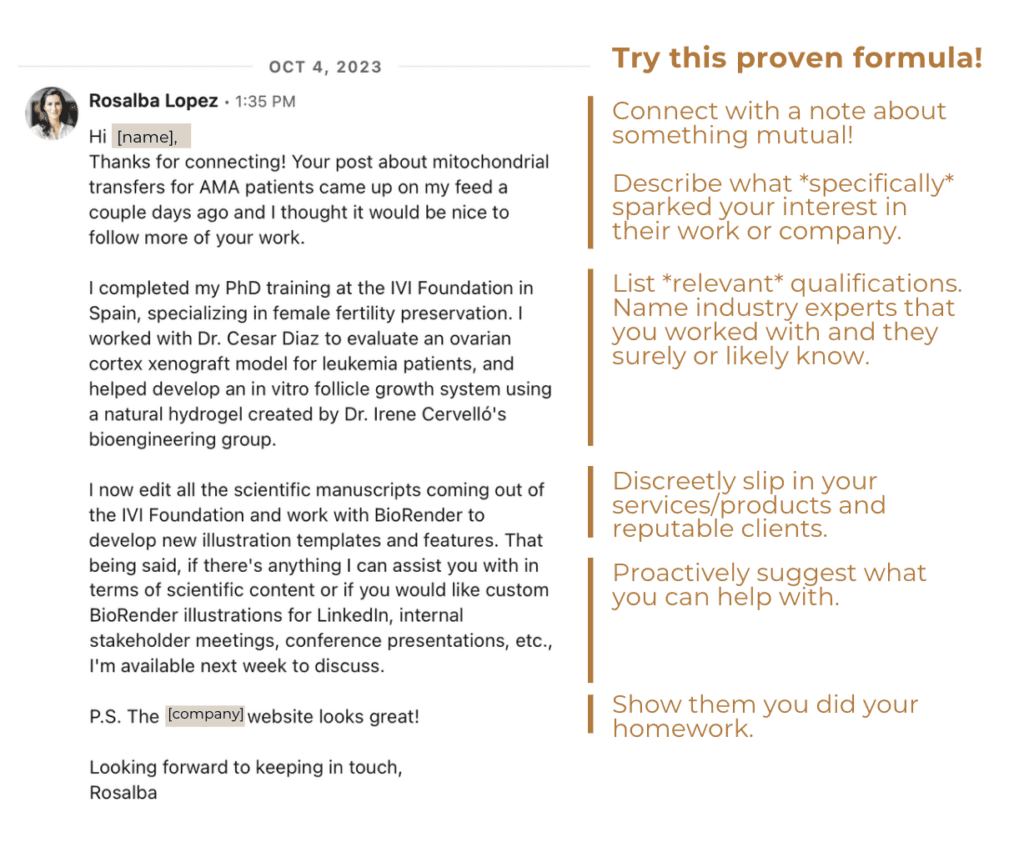
Start talking about what you’re doing. Tell anyone who is willing to listen. Share what you’re learning. Update your LinkedIn profile, reconnect with former colleagues, attend conferences and other in person networking events. And my personal favourite, send thoughtful messages to people whose work genuinely interests you. That’s where the best opportunities come from!
Here’s a real-life example of a warm pitch that secured a long-term retainer client:
You Do Not Need to Reinvent Yourself
The hardest part of leaving academia isn’t figuring out what to do next. It’s grieving the version of yourself you thought you were going to become. Science isn’t simply a career path. It is (or was) a part of our identity, representing years of sacrifice, ambition, intellectual curiosity, and belonging.
The form of my work may have changed since transitioning out of academia, but the underlying themes of my work remained consistent. Entrepreneurship allowed me to combine what I love doing: translating science into stories, teaching, running experiments, building systems, identifying patterns, and helping people make sense of complex information.
Building a freelance or consulting business doesn’t necessarily mean completely abandoning the identity you’ve spent years building. It’s simply giving yourself permission to see your expertise through a different lens and trusting that the skills you’ve spent years developing can create impact far beyond the university walls.
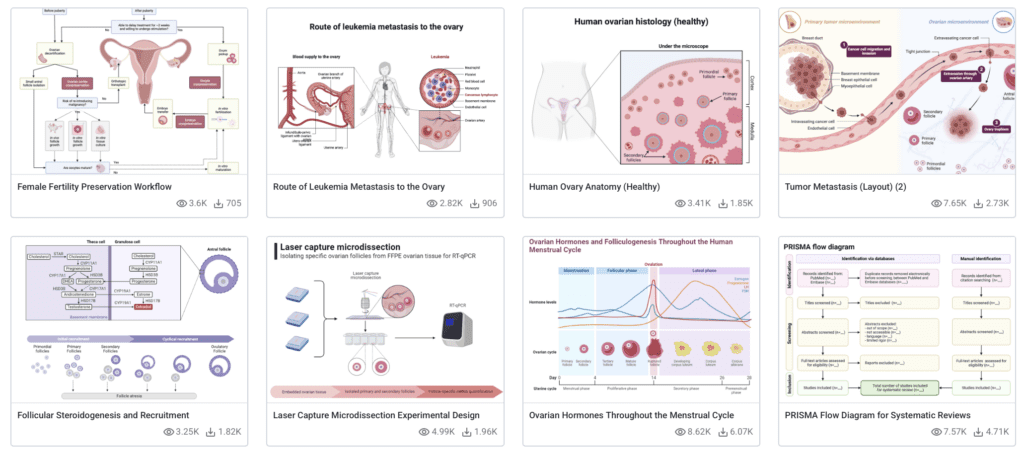
My BioRender illustrations have been downloaded over 38,000 times worldwide. Explore my portfolio here.
Absolutely. Leaving academia doesn’t have to mean rejecting science. Freelancing and consulting become ways to stay connected to the parts of science you genuinely enjoy while stepping away from the politics, grant cycles, or publish-or-perish pressures. Remember, your academic experience wasn’t wasted–your expertise remains. You’re simply applying it in new contexts.
Frequently Asked Questions About Turning Academic Expertise Into a Business
Do I need to niche down immediately?
No. In my experience, many academics discover their niche by paying attention to what clients repeatedly ask for rather than trying to choose a niche from a list. Your first few projects are often less about making money and more about collecting data.
Do I need a professional website before pitching clients?
No. The first few years I was freelancing, I attracted major opportunities through conversations and a strong LinkedIn profile. Pitches explaining who you help, how you help them, and how to contact you is often enough to get your foot in the door.
I don’t have publications in top-tier journals. Does that matter?
Usually less than you think. Clients are typically looking for someone who can solve a problem, communicate effectively, and deliver quality work on time. Reliability and responsiveness often matter far more than journal prestige–especially if you’re applying for opportunities outside of your field of study.
Leave a Reply
entrepreneurship
What to do when you're fully booked but under-earning

FEATURED on the Blog

mindset
Overcoming sales objections as a freelancer

personal branding
How Thought Leadership can grow your business

leadership
What a $9,800 mastermind weekend taught me

digital products
Starting a membership when you don't feel ready
personal branding


Entrepreneurship
How to position your expertise and story so the right opportunities (and clients) find you.
personal branding
The inner work behind confident decisions, growth, money, boundaries, and long-term resilience as a founder.
mindset
Turn your knowledge and systems into scalable offers that create income beyond client work.
digital products
How to lead with clarity and confidence while maintaining your integrity.
leadership
FOUNDATIONAL RESOURCES
Business, simplified
How I manage money, payments, and cash flow as a service-based founder.
Finance


Legal
Contract templates to protect your work, set boundaries, and avoid scope creep.
The tools and platforms I use to run my businesses as a busy toddler mom.
Systems

These are the tools I use behind-the-scenes to keep my businesses running smoothly. If you care about getting paid on time, or having contracts and systems you can rely on, start here.
Sure Strides Society is where high-acheivers go when what used to work no longer does. Demand is there, but structure isn’t, and you’re booked but everything still depends on you. Join the community to refine your positioning, clean up your systems, and build offers that scale sustainably, so your business can finally hold the level you’re stepping into.
Build a business where your work is seen, valued, and supported
For STEM freelancers, consultants, and multi-passionate founders

Be the first to comment